But I must explain to you how all this mistaken idea of denouncing pleasure and praising pain was born and will give you a complete account of the system and expound the actual teachings of the great explore
“In its language, the Constitution accepts that it cannot solve all of our society’s woes overnight, but must go on trying to resolve these problems.”
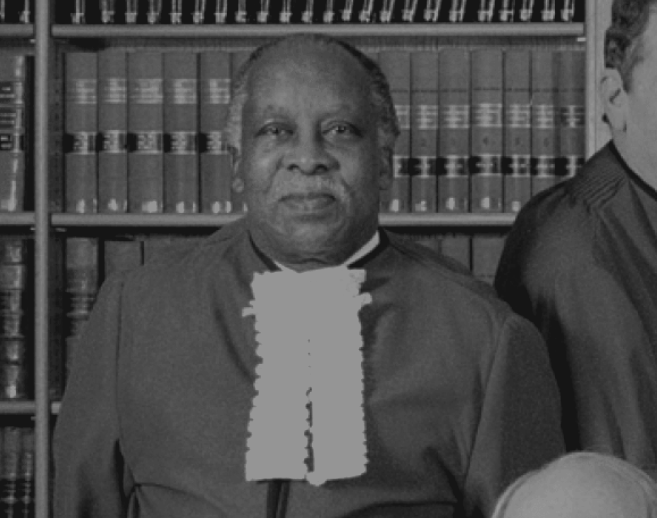
Honouring a Legacy: The Life and Impact of Justice Tholakele Hope Madala
Lawyer and passionate proponent for the rights and welfare of political prisoners, Justice Tholakele (Tholie) Hope Madala was one of the first black judges in South Africa. He was appointed to the Constitutional Court in 1994, and his judgments often expressed his strong ethos of ubuntu.
Beyond the courtroom, Justice Madala’s principles were deeply rooted in the philosophy of ubuntu, a guiding ethos reflected profoundly in his judgments. His commitment extended far beyond the confines of law; it resonated with compassion and empathy, embodying the essence of ubuntu in every decision made.
EARLY LIFE AND CAREER
Tholie Madala was born in Kokstad on 13 July 1937. After matriculating at St John’s College in Umtata in 1956, Madala went on to Fort Hare University where he obtained a BA (Rhodes) degree and a UED (SA) diploma. He taught at the Lovedale Institute in Alice and in Swaziland before taking up law at the University of Natal in Pietermaritzburg in 1972. He was instrumental in setting up the first legal aid clinic on the Pietermaritzburg campus.
Madala lectured at the University of Transkei until 1980 and thereafter practised as an attorney, and was admitted as an advocate in 1982. In his legal practice Madala handled many human rights cases, and along with several other lawyers established the Umtata Law Clinic under the auspices of the Umtata and Districts Lawyers’ Association.
From 1991 to 1993 he served as Chairperson of the Society of Advocates of Transkei. Madala took silk in 1993 and was elevated to the bench in 1994, becoming the first black judge in the Eastern Cape and the fourth black judge in South Africa. In 1995, the Legal Education Centre of the Black Lawyers Association (BLA) presented him with an award in recognition of his contribution in the area of human rights, and in April 1999 his alma mater, the University of Natal, awarded him an honorary LLD.
APPOINTMENT TO THE CONSTITUTIONAL COURT
In 1994, Madala was appointed by President Nelson Mandela to the first bench of the Constitutional Court.
Described by a former colleague, Grahamstown High Court Judge Jeremy Pickering, as “a very good, decent, modest and honourable man”, Madala performed his duties as a Constitutional Court judge with quiet, unassuming wisdom and, sometimes, understated humour.
JUDGMENTS OF INTEREST
S v Makwanyane (1995)
In his separate and concurring judgment in S v Makwanyane – the case that dealt with abolishing the death penalty in South Africa – Justice Madala expanded the value of ubuntu in our jurisprudence. He wrote of ubuntu as a “concept that permeates the Interim Constitution generally and more particularly chapter three which embodies the entrenched fundamental human rights.”
“ In my rejection of the death penalty as a form of punishment, I do not intend, nor do my colleagues, to condone murder, rape, armed robbery with aggravating circumstances and those other crimes which are punishable by a sentence of death in terms of Section 277 of the Criminal Procedure Act 51 of 1977. These criminal acts are, and remain, as heinous, vicious and as reprehensible as they ever were, and do not belong in civilised society. The death penalty is a punishment which involves so much pain and suffering that civilised society ought not to tolerate it even in spite of the present high rate of crime. And society ought to tolerate the death penalty even less when considering that it has not been proved that it has any greater deterrent effect on would-be murderers than life imprisonment. “
JUSTICE THOLIE MADALATHE MAKWANYANE JUDGMENT, 6 JUNE 1995
“ The appeal before us brings into sharp focus the dichotomy in which a changing society finds itself and in particular the problems attendant upon trying to distribute scarce resources on the one hand, and satisfying the designs of the Constitution with regard to the provision of health services on the other. It puts us in the very painful situation in which medical practitioners must find themselves daily when the question arises: “Should a doctor ever allow a patient to die when that patient has a treatable condition? “
JUSTICE THOLIE MADALATHE SOOBRAMONEY JUDGMENT, 11 NOVEMBER 1997
“ In my rejection of the death penalty as a form of punishment, I do not intend, nor do my colleagues, to condone murder, rape, armed robbery with aggravating circumstances and those other crimes which are punishable by a sentence of death in terms of Section 277 of the Criminal Procedure Act 51 of 1977. These criminal acts are, and remain, as heinous, vicious and as reprehensible as they ever were, and do not belong in civilised society. The death penalty is a punishment which involves so much pain and suffering that civilised society ought not to tolerate it even in spite of the present high rate of crime. And society ought to tolerate the death penalty even less when considering that it has not been proved that it has any greater deterrent effect on would-be murderers than life imprisonment. “
JUSTICE THOLIE MADALATHE MAKWANYANE JUDGMENT, 6 JUNE 1995
“ The appeal before us brings into sharp focus the dichotomy in which a changing society finds itself and in particular the problems attendant upon trying to distribute scarce resources on the one hand, and satisfying the designs of the Constitution with regard to the provision of health services on the other. It puts us in the very painful situation in which medical practitioners must find themselves daily when the question arises: “Should a doctor ever allow a patient to die when that patient has a treatable condition? “
JUSTICE THOLIE MADALATHE SOOBRAMONEY JUDGMENT, 11 NOVEMBER 1997
Soobramoney v Minister of Health (1997)
In a controversial judgment, the Court had to decide whether Thiagraj Soobramoney was entitled to life saving treatment by the hospital despite the fact that he could not be cured in a short period and was not eligible for a transplant because of his heart condition. Because of lack of resources, the hospital had a policy of prioritising those who could be cured within a short period and those with chronic renal failure who were eligible for a kidney transplant. The Court found that the hospital’s policy was rational and that the Court cannot interfere with hospital policy taken in good faith.
“ The appeal before us brings into sharp focus the dichotomy in which a changing society finds itself and in particular the problems attendant upon trying to distribute scarce resources on the one hand, and satisfying the designs of the Constitution with regard to the provision of health services on the other. It puts us in the very painful situation in which medical practitioners must find themselves daily when the question arises: “Should a doctor ever allow a patient to die when that patient has a treatable condition? “
JUSTICE THOLIE MADALATHE SOOBRAMONEY JUDGMENT, 11 NOVEMBER 1997
“ In my rejection of the death penalty as a form of punishment, I do not intend, nor do my colleagues, to condone murder, rape, armed robbery with aggravating circumstances and those other crimes which are punishable by a sentence of death in terms of Section 277 of the Criminal Procedure Act 51 of 1977. These criminal acts are, and remain, as heinous, vicious and as reprehensible as they ever were, and do not belong in civilised society. The death penalty is a punishment which involves so much pain and suffering that civilised society ought not to tolerate it even in spite of the present high rate of crime. And society ought to tolerate the death penalty even less when considering that it has not been proved that it has any greater deterrent effect on would-be murderers than life imprisonment. “
JUSTICE THOLIE MADALATHE MAKWANYANE JUDGMENT, 6 JUNE 1995
“ The appeal before us brings into sharp focus the dichotomy in which a changing society finds itself and in particular the problems attendant upon trying to distribute scarce resources on the one hand, and satisfying the designs of the Constitution with regard to the provision of health services on the other. It puts us in the very painful situation in which medical practitioners must find themselves daily when the question arises: “Should a doctor ever allow a patient to die when that patient has a treatable condition? “
JUSTICE THOLIE MADALATHE SOOBRAMONEY JUDGMENT, 11 NOVEMBER 1997
“ In my rejection of the death penalty as a form of punishment, I do not intend, nor do my colleagues, to condone murder, rape, armed robbery with aggravating circumstances and those other crimes which are punishable by a sentence of death in terms of Section 277 of the Criminal Procedure Act 51 of 1977. These criminal acts are, and remain, as heinous, vicious and as reprehensible as they ever were, and do not belong in civilised society. The death penalty is a punishment which involves so much pain and suffering that civilised society ought not to tolerate it even in spite of the present high rate of crime. And society ought to tolerate the death penalty even less when considering that it has not been proved that it has any greater deterrent effect on would-be murderers than life imprisonment. “
JUSTICE THOLIE MADALATHE MAKWANYANE JUDGMENT, 6 JUNE 1995
LIFE AFTER THE CONSTITUTIONAL COURT
Madala retired from the Constitutional Court in 2008. He remained a member of the Black Lawyers Association, serving as a trustee of its Legal Education Centre – a cause close to his heart. He was also the chancellor of the Anglican Diocese of St John and Deputy Chancellor of the Church of the Province of South Africa.
FAMILY AND PERSONAL LIFE
Madala was married to Patricia Alice Ndileka Madala, a non-practising advocate of the High Court. They have three children and two grandsons. He passed away on 25 August 2010.
“ He was rather quiet and dignified but his sharp sense of humour emerged from time to time. He was the sort of man you go to for advice, a father figure as it were, and he would give it to you. He had strong views of certain things, and he did not shy away from expressing them. “
FORMER CHIEF JUSTICE OF THE CONSTITUTIONAL COURTPIUS LANGA
“ The word stately comes to mind. He just had a stately presence and style. Quite a rich voice. “
FORMER JUSTICE OF THE CONSTITUTIONAL COURTALBIE SACHS
“ He affirmed that the need for ubuntu expresses the ethos of an instinctive capacity for, and enjoyment of love towards our fellow men and women, the joy and fulfilment involved in recognising their innate humanity, the reciprocity this generates in interaction within the collective community, the richness of the collective emotions which it engenders and the moral energies which it releases both in the givers and the society which they serve.
He pursued a life dedicated to serving the underdog. A common thread in his professional pursuits is that he was not motivated by glamour or financial prosperity but by the zeal to deliver justice to all people alike.
“
FORMER MINISTER OF JUSTICE AND CONSTITUTIONAL DEVELOPMENTJEFF RADEBE
“ His chambers were right next door to mine. So he would pop in my chambers anytime, and I would do likewise. And he had this thing he liked to say, he would come in, there I am sitting behind my desk, busy working, and he never failed to come in, stand at the door and say, are you working hard, or hardly working? I was sort of, you know, his ‘son’, in quotation marks, at the Bar. And when I came to work with him here, it was such a pleasure. “
JUSTICE OF THE CONSTITUTIONAL COURTMBUYISELI MADLANGA
“ His pen has contributed, in no small way to the development of our constitutional jurisprudence. Time and space do not permit me to do justice to analysing, and exposing the richness of his judgments, which display a rare profundity of thought. “
UNIVERSITY OF FORT HARE CHANCELLORADV. DUMISA NTSEBEZA SC
“ He was rather quiet and dignified but his sharp sense of humour emerged from time to time. He was the sort of man you go to for advice, a father figure as it were, and he would give it to you. He had strong views of certain things, and he did not shy away from expressing them. “
FORMER CHIEF JUSTICE OF THE CONSTITUTIONAL COURTPIUS LANGA
“ The word stately comes to mind. He just had a stately presence and style. Quite a rich voice. “
FORMER JUSTICE OF THE CONSTITUTIONAL COURTALBIE SACHS
“ He affirmed that the need for ubuntu expresses the ethos of an instinctive capacity for, and enjoyment of love towards our fellow men and women, the joy and fulfilment involved in recognising their innate humanity, the reciprocity this generates in interaction within the collective community, the richness of the collective emotions which it engenders and the moral energies which it releases both in the givers and the society which they serve.
He pursued a life dedicated to serving the underdog. A common thread in his professional pursuits is that he was not motivated by glamour or financial prosperity but by the zeal to deliver justice to all people alike.
“
FORMER MINISTER OF JUSTICE AND CONSTITUTIONAL DEVELOPMENTJEFF RADEBE
“ His chambers were right next door to mine. So he would pop in my chambers anytime, and I would do likewise. And he had this thing he liked to say, he would come in, there I am sitting behind my desk, busy working, and he never failed to come in, stand at the door and say, are you working hard, or hardly working? I was sort of, you know, his ‘son’, in quotation marks, at the Bar. And when I came to work with him here, it was such a pleasure. “
JUSTICE OF THE CONSTITUTIONAL COURTMBUYISELI MADLANGA
“ His pen has contributed, in no small way to the development of our constitutional jurisprudence. Time and space do not permit me to do justice to analysing, and exposing the richness of his judgments, which display a rare profundity of thought. “
UNIVERSITY OF FORT HARE CHANCELLORADV. DUMISA NTSEBEZA SC